
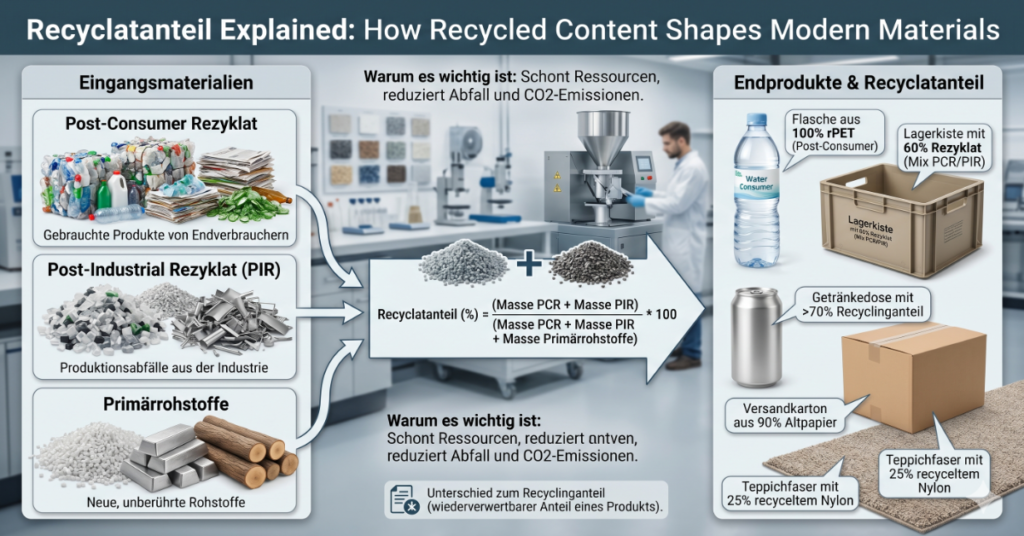
Recyclatanteil refers to the percentage of recycled material used in a product or its packaging. It is a central metric in sustainability reporting because it quantifies how much of a material comes from recycled sources instead of virgin raw materials. In plastics, for example, it measures the share of processed waste such as PET bottles or industrial scrap that has been transformed into reusable granules for new production.
Understanding recyclatanteil is important because it connects environmental policy with industrial practice. Governments, especially within the European Union, are increasingly requiring higher recycled content in packaging. This has made recyclatanteil a measurable benchmark for compliance, innovation, and consumer transparency.
The concept is not purely theoretical. It directly affects how packaging is designed, how materials are sourced, and how brands communicate sustainability claims. Companies that increase recyclatanteil reduce dependence on fossil-based raw materials while contributing to circular economy systems. At the same time, industries must balance this with technical constraints such as material strength, color stability, and contamination risks.
In recent years, recyclatanteil has become a marketing term as well as a regulatory one. However, this dual role introduces complexity, especially when consumers attempt to distinguish genuine recycled content from vague sustainability claims. Understanding how recyclatanteil is measured and applied helps clarify both its potential and its limitations in modern production systems.
What Recyclatanteil Means in Practice
Recyclatanteil is a quantifiable ratio used in industrial production to determine how much recycled input is used in manufacturing. It includes both pre-consumer recyclates (industrial scrap reused before reaching consumers) and post-consumer recyclates (materials recovered after consumer use, such as PET bottles).
Recyclatanteil=Masse an RecyclingmaterialGesamtmaterial×100%\text{Recyclatanteil} = \frac{\text{Masse an Recyclingmaterial}}{\text{Gesamtmaterial}} \times 100\%Recyclatanteil=GesamtmaterialMasse an Recyclingmaterial×100%
In plastics, recyclates are processed through sorting, shredding, washing, and granulation before being reused in production. This process is central to maintaining material quality while reducing reliance on virgin polymers.
A key distinction exists between closed-loop and open-loop systems. Closed-loop recycling maintains material within the same product type, such as bottle-to-bottle PET recycling. Open-loop recycling downgrades material into different applications, such as turning packaging waste into textile fibers.
Pre-Consumer vs Post-Consumer Recyclates
| Category | Source | Example | Quality Level | Typical Use |
| Pre-consumer | Manufacturing waste | Factory offcuts | High consistency | Industrial reuse |
| Post-consumer | End-user waste | Used PET bottles | Variable quality | Packaging, textiles |
Pre-consumer materials generally require less processing, while post-consumer recyclates depend heavily on collection systems and contamination levels. This difference directly affects achievable recyclatanteil in final products.
Why Recyclatanteil Matters for Industry and Policy
Recyclatanteil plays a critical role in aligning manufacturing with environmental policy. The European Union has set targets requiring increasing levels of recycled content in packaging, with goals reaching 30% or higher in many plastic categories by 2030.
These policies influence procurement decisions, material innovation, and supply chain design. Companies that fail to increase recyclatanteil risk regulatory penalties or loss of market competitiveness.
From a strategic perspective, recyclatanteil also affects carbon accounting. Using recycled materials often reduces energy consumption compared to virgin plastic production, although the exact savings depend on processing efficiency and transport logistics.
Industry Applications and Real-World Use
Many consumer goods brands now display recyclatanteil information on packaging. This includes food containers, beverage bottles, and household products. The goal is to increase transparency and allow consumers to evaluate sustainability claims.
For example, PET bottle recycling systems in Europe frequently report recycled content rates in the range of 25% to 100% depending on product type and market availability. However, variability remains due to feedstock quality and production constraints.
A structured view of industry application:
| Sector | Typical Recyclatanteil Range | Main Constraint |
| Beverage packaging | 25%–100% | Food safety standards |
| Textiles | 10%–80% | Fiber durability |
| Automotive parts | 5%–50% | Mechanical strength |
| Consumer packaging | 20%–70% | Color consistency |
This variability shows that recyclatanteil is not a fixed target but a flexible engineering parameter influenced by use-case requirements.
Production Challenges and Trade-offs
Increasing recyclatanteil introduces several technical and economic challenges.
One major issue is material degradation. Recycled plastics can lose strength after repeated processing cycles. This requires blending with virgin material to maintain performance standards.
Another challenge is color inconsistency. Post-consumer recyclates often produce non-uniform coloration, which limits their use in transparent or premium packaging.
Supply chain reliability also plays a role. The availability of high-quality recyclates fluctuates based on collection infrastructure and consumer behavior.
These constraints mean that increasing recyclatanteil is not simply a policy decision but an engineering optimization problem.
Hidden Industry Insights
One overlooked factor is the energy trade-off. While recycled materials reduce raw material extraction, sorting and purification processes can increase energy use in certain cases. This creates a threshold where environmental benefits depend on processing efficiency.
Another insight is that recyclatanteil claims vary significantly depending on measurement standards. Some companies report mass-based content, while others include allocation methods that can inflate percentages.
A third observation is that high recyclatanteil does not always correlate with recyclability. A product may contain recycled material but still be difficult to recycle again due to additives or composite layers.
The Future of Recyclatanteil in 2027
By 2027, recyclatanteil is expected to become more standardized due to stricter EU packaging regulations and harmonized reporting frameworks. The European Green Deal and Circular Economy Action Plan are pushing toward mandatory recycled content disclosures and minimum thresholds in packaging categories.
Digital product passports are also expected to play a role in tracking material composition across supply chains. This will improve transparency and reduce greenwashing risks.
Technological improvements in chemical recycling may also expand the availability of high-purity recyclates, potentially increasing achievable recyclatanteil in food-grade packaging and engineering plastics.
However, infrastructure limitations in collection and sorting systems will remain a bottleneck, especially outside major EU markets.
Key Insights
- Recyclatanteil is both a technical metric and a regulatory requirement
- Achieving high recycled content depends on material type and application constraints
- Transparency standards are evolving but still inconsistent across industries
- Chemical recycling may expand future supply of high-quality recyclates
- Measurement differences can significantly affect reported values
- Infrastructure remains the limiting factor in scaling circular material systems
Conclusion
Recyclatanteil is a foundational concept in modern sustainable manufacturing. It connects material science, environmental regulation, and consumer transparency into a single measurable indicator. While it supports circular economy goals, its implementation is constrained by technical limitations, supply chain variability, and inconsistent reporting standards.
As industries move toward stricter sustainability requirements, recyclatanteil will likely become more standardized and widely enforced. However, its effectiveness will depend on improvements in recycling infrastructure and material processing technologies. Understanding both its potential and limitations is essential for evaluating real progress in sustainable production systems.
Structured FAQ
What does recyclatanteil mean?
It refers to the percentage of recycled material used in a product or packaging. It measures how much of the material comes from reused sources rather than virgin raw materials.
What is the difference between pre-consumer and post-consumer recyclate?
Pre-consumer recyclates come from industrial waste before consumer use, while post-consumer recyclates come from used products like bottles or packaging collected after disposal.
Why is recyclatanteil important for the EU?
The EU uses it to enforce circular economy policies, reduce waste, and increase recycled content in packaging under environmental regulations.
Can recyclatanteil be 100%?
Yes, in some controlled applications like certain PET bottle systems, but it is often limited by quality and safety requirements.
Does higher recyclatanteil always mean better sustainability?
Not always. Energy use, processing methods, and product recyclability also affect overall environmental impact.
How is recyclatanteil calculated?
It is calculated by dividing the mass of recycled material by total material mass and multiplying by 100.
What are common challenges in increasing recyclatanteil?
Material contamination, color variation, supply shortages, and mechanical performance limitations are key challenges.
Methodology
This article is based on synthesis of publicly available sustainability frameworks, including European Union circular economy policy documentation, plastics recycling industry reports, and materials science research summaries published between 2023 and 2025. Technical explanations reflect established recycling processes used in PET and polymer manufacturing industries.
Limitations include variability in reporting standards across manufacturers and lack of uniform global definitions for recycled content measurement. Figures and thresholds are generalized from aggregated industry sources rather than a single dataset. No proprietary industrial testing was conducted for this analysis.