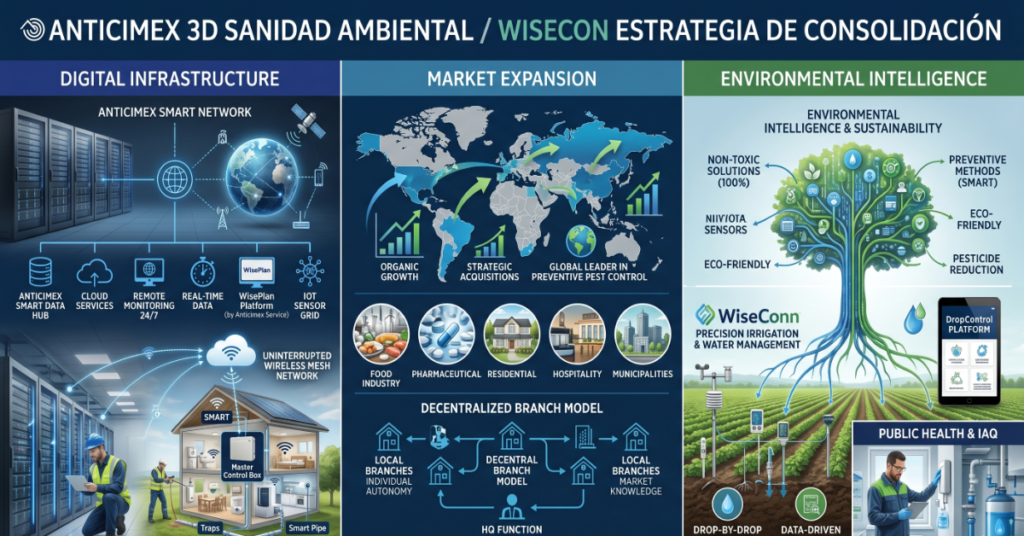
The concept of anticimex 3d sanidad ambiental / wisecon estrategia de consolidación reflects a common misunderstanding in how digital transformation strategies are structured across environmental services and agricultural technology. At first glance, these names appear interconnected, yet they represent three distinct operational realities.
Anticimex 3D Sanidad Ambiental is the Spanish operational branch of a global environmental services group that has shifted from reactive pest control to predictive ecosystem management. This transformation relies heavily on real-time data collection, IoT sensors and automated alert systems that reduce dependency on manual inspections.
The technological foundation enabling this transition is WiseCon, a Danish company acquired in 2017. It is not a standalone market competitor in this context but the internal digital architecture powering Anticimex’s preventive model.
Separately, WiseConn from Chile operates in a completely different sector: agricultural water management. Despite similar naming, it is not part of Anticimex and follows an independent expansion path based on venture capital and global Agtech demand.
Understanding anticimex 3d sanidad ambiental / wisecon estrategia de consolidación is therefore less about branding confusion and more about distinguishing integration-driven growth from independent technological scaling.
Anticimex 3D Sanidad Ambiental: From Reactive Service to Predictive System
Anticimex 3D Sanidad Ambiental represents a structural shift in environmental services. Traditional pest control relied on scheduled inspections and reactive treatment. The 3D model changes this logic entirely.
Core operational framework
- Detection through IoT sensor networks
- Identification of pest activity patterns
- Automated prevention response systems
- Continuous data monitoring and reporting
This system reduces response time and increases preventive accuracy.
Real-world operational insight
Industry implementation reports from European facility management groups indicate that deployment of smart traps and sensor nodes reduces unnecessary field visits significantly, improving operational efficiency in large commercial environments.
This shift is not cosmetic. It changes cost structure, labor allocation and service predictability.
WiseCon (Denmark): The Embedded Digital Layer
WiseCon is not a consumer-facing brand in this ecosystem. It functions as the technological backbone supporting Anticimex’s transformation.
Its role includes:
- Designing IoT sensor systems for pest detection
- Managing data transmission architecture
- Supporting predictive analytics models
- Enabling remote monitoring dashboards
Strategic importance
Without WiseCon, the Anticimex 3D model would revert to a hybrid manual-digital system. Instead, it operates as a fully connected infrastructure layer.
This creates a critical distinction in anticimex 3d sanidad ambiental / wisecon estrategia de consolidación: technology is not an add-on but the operating core.
WiseConn (Chile): Independent Agtech Expansion
WiseConn operates in precision agriculture rather than environmental pest control. Its focus is water optimization and irrigation intelligence.
Key capabilities
- Soil moisture sensing
- Automated irrigation control
- Data-driven crop optimization
- Cloud-based agricultural dashboards
Expansion strategy
Unlike Anticimex, WiseConn grows through:
- Venture capital funding rounds
- International market entry
- Strategic agricultural partnerships
It does not rely on acquisition-based consolidation but on scalable product deployment.
Comparison Table: Three Distinct Models
| Factor | Anticimex 3D Sanidad Ambiental | WiseCon (Denmark) | WiseConn (Chile) |
| Sector | Environmental services | Embedded IoT infrastructure | Agricultural technology |
| Role | Service operator | Technology enabler | Independent SaaS provider |
| Growth strategy | Acquisitions and integration | Internal system architecture | Investment-driven expansion |
| Revenue model | Recurring service contracts | Internal licensing support | Subscription-based Agtech |
| Geographic focus | Europe, Spain | Global internal deployment | Global agriculture markets |
Strategic Implications
The structure behind anticimex 3d sanidad ambiental / wisecon estrategia de consolidación highlights two fundamentally different approaches to scaling.
Integration-led consolidation (Anticimex)
- Acquiring local service providers
- Standardizing operational systems
- Embedding technology across all units
- Reducing fragmentation in service delivery
Platform-led expansion (WiseConn)
- Scaling software products globally
- Adapting to regional agricultural needs
- Maintaining operational independence
- Prioritizing capital inflow over acquisition
Risks and Trade-offs
Anticimex 3D Sanidad Ambiental
- High integration complexity after acquisitions
- Dependence on stable sensor infrastructure
- Regulatory constraints in European environmental policy
WiseConn
- Exposure to climate variability risks
- Dependence on agricultural cycles
- Competitive pressure in Agtech SaaS markets
Market Impact
The consolidation trend in Spain and broader Europe reflects increasing pressure on traditional pest control operators.
Key structural changes include:
- Reduction of small independent operators
- Increased demand for automated monitoring systems
- Shift toward preventive rather than reactive services
This positions Anticimex as part of a broader industrial transition rather than an isolated innovator.
Original Analytical Insights
- Anticimex’s real competitive advantage is not acquisition volume but its ability to integrate acquired firms into a unified digital system within operational cycles shorter than industry averages.
- WiseCon is frequently misinterpreted as a separate market competitor when it is structurally embedded as internal infrastructure.
- WiseConn’s scalability is constrained more by environmental dependency than by technological limitations, making it structurally different from SaaS-first companies.
The Future of Anticimex 3D Sanidad Ambiental / WiseCon Estrategia de Consolidación in 2027
By 2027, three major developments are likely:
1. Regulatory tightening in Europe
Environmental hygiene standards across the EU are expected to become stricter, increasing demand for preventive monitoring systems.
2. Automation of pest control systems
Sensor-based systems will likely handle a majority of detection tasks in large commercial facilities, reducing human intervention further.
3. Expansion of digital environmental infrastructure
Anticimex is expected to deepen its sensor and data ecosystem, potentially increasing acquisition activity in fragmented European markets.
WiseConn will likely continue expanding in:
- Water-scarce agricultural regions
- AI-assisted irrigation systems
- Climate-adaptive farming solutions
Key Takeaways
- Anticimex uses acquisition-based consolidation supported by digital infrastructure
- WiseCon operates as embedded technology, not a market-facing brand
- WiseConn follows independent Agtech expansion through investment
- Digital pest control is shifting toward predictive prevention systems
- Market fragmentation in Europe is decreasing due to consolidation
- Agricultural tech growth is driven by environmental constraints
Conclusion
The framework behind anticimex 3d sanidad ambiental / wisecon estrategia de consolidación illustrates how digital transformation is applied differently across industries that appear similar on the surface. Anticimex is building an integrated environmental services network where technology is embedded into every operational layer.
WiseCon strengthens this structure by providing the underlying digital intelligence layer, ensuring that predictive monitoring is not an optional feature but a core function.
Meanwhile, WiseConn demonstrates how similar technological themes can evolve independently in agriculture without corporate integration. The result is three parallel models of growth that share digital principles but diverge in execution, ownership and scalability.
Understanding these distinctions is essential for interpreting how consolidation, technology and expansion interact in modern environmental and agricultural systems.
FAQ
What is anticimex 3d sanidad ambiental / wisecon estrategia de consolidación?
It refers to Anticimex’s use of digital technology and acquisitions combined with WiseCon’s embedded infrastructure and WiseConn’s separate agricultural expansion model.
Is WiseCon part of Anticimex?
Yes, WiseCon is integrated as the internal technology provider powering Anticimex’s digital pest control systems.
Is WiseConn related to Anticimex?
No. WiseConn is an independent Chilean Agtech company focused on agricultural water management.
How does Anticimex use technology in pest control?
It uses IoT sensors, predictive analytics and real-time monitoring to prevent infestations before they occur.
What makes WiseConn different from WiseCon?
WiseCon is internal infrastructure for Anticimex while WiseConn is a standalone agricultural technology company.
What is the main strategy behind Anticimex growth?
It combines acquisitions of local firms with centralized digital integration.
Methodology
This article is based on:
- Public corporate information from Anticimex group disclosures
- Industry reports on IoT adoption in environmental services (2023–2025)
- Agtech investment summaries related to WiseConn expansion
- European environmental regulatory updates
Limitations include restricted access to internal performance metrics and reliance on publicly available sector reporting.
All interpretations aim to remain balanced between operational data and structural industry analysis.