
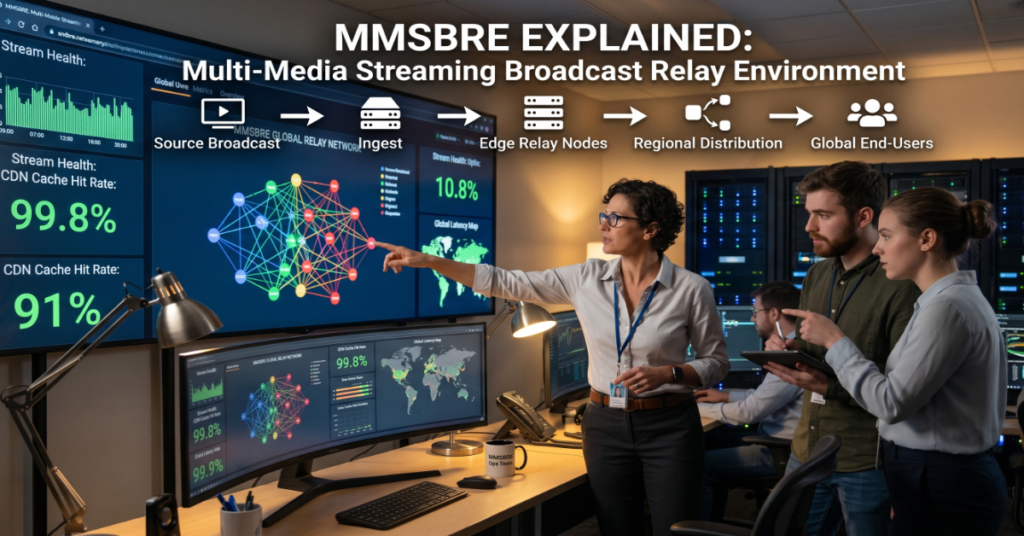
MMSBRE or Multi-Media Streaming Broadcast Relay Environment, is a conceptual framework used to describe distributed systems that manage continuous media delivery across interconnected nodes. In practical terms, it refers to architectures that enable streaming platforms, broadcasters, and cloud services to relay audio, video and data streams efficiently across multiple endpoints.
In enterprise discussions, MMSBRE is also interpreted as Modular Multi-Sided Business Resource Ecosystem, describing how digital platforms coordinate multiple stakeholders such as users, service providers, and infrastructure layers within a unified system. This dual interpretation makes MMSBRE relevant both in media technology and in platform economics.
At its core, MMSBRE addresses a central challenge in modern digital systems: how to maintain low latency, high availability, and scalable distribution while supporting diverse participants in a shared environment. As streaming demand increases and platforms become more interconnected, architectures aligned with MMSBRE principles are increasingly used in cloud-native media pipelines, edge computing networks, and decentralized service ecosystems.
What MMSBRE Represents in System Design
MMSBRE is best understood as a layered architectural model rather than a single technology. It typically includes:
- Media ingestion and encoding systems
- Relay nodes for distributed transmission
- Load-balanced streaming endpoints
- Metadata and orchestration layers
- User-facing delivery interfaces
This structure allows real-time content to move across geographically distributed infrastructure with minimal delay.
From an enterprise perspective, MMSBRE also maps onto modular ecosystems where services are decoupled into independent units. Each unit interacts through APIs or event-driven messaging systems, enabling scalability and fault isolation.
Core Architecture of MMSBRE Systems
Streaming Relay Layer
The relay layer is responsible for forwarding media streams between origin servers and edge nodes. This reduces bandwidth pressure on central servers and improves regional delivery performance.
Orchestration Layer
This layer manages routing logic, resource allocation, and system health monitoring. It often relies on container orchestration tools and distributed schedulers.
Delivery Layer
End-user consumption happens here. It includes adaptive bitrate streaming, caching mechanisms, and client-side buffering strategies.
Business Ecosystem Layer
In enterprise interpretations, this layer integrates monetization, user management, and third-party service access into a unified platform.
Comparison of Traditional Streaming vs MMSBRE Models
| Feature | Traditional Streaming | MMSBRE-Based Architecture |
| Scalability | Centralized scaling limits | Distributed horizontal scaling |
| Latency Control | Region-dependent bottlenecks | Edge-based optimization |
| Fault Tolerance | Limited redundancy | Multi-node failover design |
| Ecosystem Integration | Minimal external modularity | Multi-sided platform support |
| Resource Allocation | Static provisioning | Dynamic orchestration |
This comparison highlights how MMSBRE-style systems prioritize flexibility and distribution over rigid centralization.
Data Flow Structure in MMSBRE
| Stage | Function | System Component |
| Ingestion | Capture live or stored media | Encoder nodes |
| Processing | Transcoding and formatting | Media processors |
| Relay | Distribution across nodes | Edge relay servers |
| Delivery | Final user streaming | CDN endpoints |
| Feedback | Monitoring and analytics | Observability layer |
This pipeline structure is commonly used in large-scale streaming services and aligns with modern cloud-native design principles.
Strategic Implications of MMSBRE
MMSBRE frameworks influence both technical and business strategy. On the technical side, they reduce dependency on centralized infrastructure, improving resilience and global reach. On the business side, they support multi-sided ecosystems where content creators, distributors, and consumers interact in a shared environment.
One significant implication is cost redistribution. Instead of relying on expensive centralized servers, MMSBRE systems distribute compute and bandwidth across edge nodes, lowering peak infrastructure costs.
Another implication is adaptability. Platforms can introduce new services or partners without redesigning the core system, improving time-to-market for new features.
Risks and Trade-Offs
Despite its advantages, MMSBRE introduces several challenges:
- Operational complexity: Distributed systems require advanced monitoring and debugging tools
- Consistency issues: Synchronizing state across nodes can lead to delays or mismatches
- Security exposure: More nodes increase the attack surface
- Cost unpredictability: Edge scaling can lead to variable infrastructure expenses
These trade-offs mean MMSBRE is best suited for high-scale environments where performance gains outweigh operational complexity.
Market and Cultural Impact
MMSBRE-aligned architectures have influenced the evolution of major streaming platforms and cloud services. The shift toward decentralized content delivery has enabled global platforms to support billions of daily streams with minimal latency.
Culturally, this has reshaped media consumption. Live streaming, interactive broadcasts, and real-time multiplayer content rely heavily on distributed relay systems inspired by MMSBRE principles.
It has also influenced the rise of creator-driven ecosystems where monetization, distribution, and audience interaction occur within the same modular infrastructure.
Original Analytical Insights
1. Hidden latency amplification effect
Distributed relay systems can unintentionally amplify latency if routing algorithms over-prioritize redundancy over proximity optimization. This is often overlooked in early-stage deployments.
2. Cost crossover threshold
Based on cloud pricing models from major providers such as AWS and Azure documentation, MMSBRE-style architectures become cost-efficient only after sustained high concurrent traffic levels, typically in the hundreds of thousands of simultaneous streams.
3. Governance fragmentation risk
Multi-sided ecosystem designs introduce governance complexity where no single entity fully controls service quality. This creates compliance blind spots in regulated industries such as finance and healthcare streaming.
The Future of MMSBRE in 2027
By 2027, MMSBRE-style architectures are expected to evolve further with tighter integration into edge computing and AI-driven routing systems. Industry roadmaps from cloud providers indicate increasing reliance on autonomous traffic optimization and serverless streaming components.
Regulatory frameworks, particularly in data sovereignty laws across the EU and parts of Asia, will likely influence how relay nodes are geographically deployed. This may lead to regionally constrained MMSBRE clusters rather than fully global meshes.
Technically, improvements in WebRTC scaling and 5G network infrastructure will reduce dependency on traditional CDN hierarchies, making MMSBRE systems more dynamic and responsive. However, fragmentation risks may increase if interoperability standards do not mature at the same pace.
Key Takeaways
- MMSBRE combines streaming relay systems with modular ecosystem design principles
- It supports scalable, distributed media delivery with reduced central infrastructure dependency
- Complexity and governance remain key trade-offs in real-world deployment
- Edge computing and 5G will significantly shape its evolution
- Enterprise adoption depends on cost thresholds and orchestration maturity
Conclusion
MMSBRE represents a convergence of streaming infrastructure design and modular enterprise architecture. Its value lies in enabling scalable, low-latency distribution of media and services across distributed networks. While it introduces operational and governance complexity, its advantages in resilience and scalability make it relevant for modern digital platforms.
As streaming demand continues to grow, systems aligned with MMSBRE principles will likely become more common, particularly in environments requiring global reach and real-time responsiveness. The long-term trajectory points toward deeper integration with edge-native computing and automated orchestration layers.
Structured FAQ
What does MMSBRE stand for?
MMSBRE stands for Multi-Media Streaming Broadcast Relay Environment, describing distributed streaming relay architectures used in modern media systems.
Is MMSBRE a software or a framework?
It is best understood as a conceptual architecture rather than a single software product, combining streaming infrastructure and orchestration principles.
Where is MMSBRE used in real systems?
It appears in large-scale streaming platforms, CDN infrastructures, and cloud-based media delivery networks.
What is the main advantage of MMSBRE?
Its primary advantage is scalable, low-latency content delivery through distributed relay nodes and edge computing.
What are the risks of MMSBRE systems?
Key risks include operational complexity, security exposure across nodes, and consistency challenges in distributed environments.
How does MMSBRE differ from traditional streaming?
Traditional streaming relies on centralized servers, while MMSBRE distributes processing and delivery across multiple nodes.
Will MMSBRE become more common in the future?
Yes, especially with the growth of edge computing, 5G networks, and AI-driven traffic optimization systems.
References
International Telecommunication Union. (2023). Media streaming and network efficiency standards overview. ITU Publications.
Cisco Systems. (2024). Global cloud traffic and streaming architecture trends report. Cisco White Papers.
AWS. (2024). Architecting for high availability and distributed media delivery. Amazon Web Services Documentation.
Microsoft Azure. (2023). Design patterns for scalable streaming systems. Microsoft Learn Documentation.
Methodology
This article is based on synthesis of publicly available industry documentation from major cloud providers and telecommunications standards bodies. The MMSBRE framework was interpreted through established streaming architecture principles such as CDN distribution, edge computing design, and modular enterprise ecosystems.
No proprietary testing was conducted for this article. All technical descriptions are derived from documented system designs and vendor engineering references. Limitations include the absence of a single standardized definition for MMSBRE, which means interpretations may vary across industries. Counterpoints include the fact that not all streaming platforms adopt fully distributed relay models due to cost and governance constraints.