
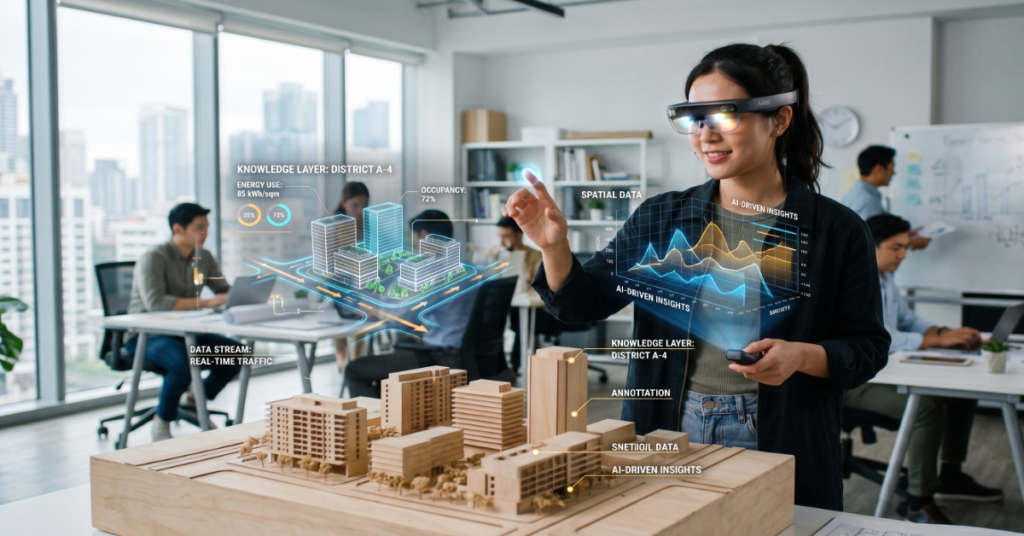
ARK augmented reality refers to a research concept that integrates artificial intelligence with augmented reality systems to create environments that understand, adapt, and evolve based on context. Unlike traditional AR systems that simply overlay digital objects onto physical space, ARK augmented reality introduces a reasoning layer that allows digital elements to behave intelligently within real-world scenes.
Within the first wave of AR systems, most applications relied on static 3D assets or rule-based interactions. In contrast, ARK augmented reality introduces a shift toward knowledge-driven spatial computing where systems can interpret what they see, remember past interactions, and generate new scene elements dynamically using AI models such as large language models and multimodal vision systems. This makes AR experiences feel less like overlays and more like interactive digital extensions of reality.
At its core, ARK augmented reality explores how foundation models can be embedded into spatial environments. These models draw from structured knowledge bases, user interaction history, and real-time sensory input to generate context-aware outputs. This enables a system where a virtual object is not just placed in space but understood in relation to its surroundings.
Research efforts, particularly from Microsoft Research, have positioned ARK augmented reality as a foundational step toward next generation mixed reality systems. These systems aim to support long-term memory, adaptive reasoning, and cross-modal interaction across vision, language, and spatial data.
Core Architecture of ARK Augmented Reality
ARK augmented reality systems are built around three primary components: perception, knowledge reasoning, and spatial generation.
1. Perception Layer
This layer processes real-world input using cameras, depth sensors, and environmental mapping. It identifies objects, surfaces, and spatial relationships.
2. Knowledge Reasoning Layer
Here, large models interpret the scene using external data sources such as knowledge graphs and pretrained language models. This is where semantic understanding emerges.
3. Generation Layer
The system generates or modifies 2D and 3D objects based on reasoning outputs. This includes adjusting lighting, object behavior, or spatial logic.
System Comparison
| Feature | Traditional AR | ARK Augmented Reality |
| Scene Understanding | Minimal or rule-based | Semantic and AI-driven |
| Object Placement | Static overlays | Context-aware generation |
| Memory Capability | None | Persistent interaction memory |
| Adaptation | Limited | Continuous and dynamic |
| Data Sources | Local assets only | Knowledge graphs + LLMs |
How ARK Augmented Reality Differs From Standard AR
Traditional AR systems like ARKit rely heavily on predefined object tracking and placement rules. ARK augmented reality introduces a deeper reasoning layer that fundamentally changes how scenes are constructed.
Instead of placing a virtual chair in a room, an ARK system evaluates whether the chair fits the environment, whether it matches user intent, and whether prior interactions suggest a different object would be more useful.
This shift is critical because it moves AR from a display technology to a cognitive system. In practical terms, ARK augmented reality behaves more like an assistant embedded in space rather than a rendering engine.
Strategic Implications of ARK Augmented Reality
The rise of ARK augmented reality has implications across several industries.
1. Spatial Interfaces Become Intelligent
Interfaces are no longer static. They adapt based on user behavior, context, and environment.
2. Reduced Need for Manual Asset Design
Instead of prebuilding every 3D object, systems can generate assets dynamically.
3. Long-Term Interaction Memory
Users can return to a space and find that it has evolved based on previous interactions.
Impact Analysis
| Sector | Expected Impact |
| Gaming | Adaptive worlds that evolve with player behavior |
| Education | Personalized simulations based on learning progress |
| Remote Work | Context-aware shared workspaces |
| Healthcare Training | Adaptive procedural simulations |
| Design & Architecture | Real-time generative environment modeling |
Risks and Trade-Offs
While ARK augmented reality offers significant potential, it introduces several challenges.
Computational Complexity
Running multimodal AI models in real time requires substantial compute resources, limiting accessibility on lightweight devices.
Data Privacy Concerns
Persistent memory systems raise questions about how user interaction data is stored and used.
Hallucination in Spatial Context
AI-generated spatial reasoning can produce inaccurate or unsafe object placements if not carefully constrained.
Original Analytical Insights
Insight 1: Spatial Drift Risk
One under-discussed challenge is spatial drift, where AI-generated objects gradually diverge from physical alignment due to compounding inference errors over time.
Insight 2: Context Overload Problem
As ARK augmented reality systems accumulate memory, they risk overfitting environments to past behavior, reducing spontaneity in new interactions.
Insight 3: Semantic Conflict in Shared Spaces
In multi-user environments, conflicting semantic interpretations can cause inconsistent scene generation between users.
Real-World Use Cases
ARK augmented reality is not yet a consumer product, but its principles are already influencing adjacent systems.
Metaverse Environments
Persistent worlds where objects evolve based on collective user behavior.
Enterprise Collaboration
Shared spatial workspaces that adjust layout and tools based on meeting history.
Training Systems
Adaptive simulations for emergency response and medical procedures.
The Future of ARK Augmented Reality in 2027
By 2027, ARK augmented reality systems are expected to align more closely with lightweight edge AI and wearable AR hardware.
Several trends are shaping this trajectory:
- On-device multimodal models reducing reliance on cloud inference
- Standardization of spatial memory APIs across AR platforms
- Regulatory focus on spatial data privacy and persistent environmental tracking
- Integration with enterprise productivity ecosystems
However, limitations in hardware scalability and real-time reasoning latency may slow full consumer adoption.
Takeaways
- ARK augmented reality shifts AR from static overlays to intelligent spatial systems
- Its core strength lies in combining AI reasoning with environmental perception
- Persistent memory introduces both capability gains and privacy risks
- Real-time deployment remains constrained by compute limitations
- Enterprise and training applications are likely to lead adoption
- Semantic consistency in shared spaces remains a key technical challenge
Conclusion
ARK augmented reality represents a structural change in how digital systems interact with physical environments. Instead of treating AR as a visual enhancement layer, it reframes it as a reasoning system that understands space, context, and user intent.
This shift introduces new possibilities for education, collaboration, and simulation, but it also exposes unresolved challenges in privacy, compute efficiency, and semantic reliability. As the technology matures, its impact will depend less on visual fidelity and more on how effectively it can reason about the world it is embedded in.
The most important transition is not visual but cognitive, moving from augmented display systems to augmented intelligence systems embedded in space.
FAQ
What is ARK augmented reality in simple terms?
It is a research concept where AR systems use AI to understand and adapt to real-world environments instead of just placing static digital objects.
How is ARK augmented realit’y different from ARKit?
ARK focuses on semantic understanding and AI reasoning, while ARKit focuses on object tracking and placement.
Does ARK augmented realit’y exist as a consumer app?
No. It is primarily a research framework developed in academic and industrial AI labs.
What technologies power ARK augmented realit’y?
It combines large language models, vision systems, spatial mapping, and knowledge graphs.
Why is memory important in ARK systems?
Memory allows the system to maintain continuity across interactions and adapt environments over time.
Can ARK augmented realit’y run on mobile devices?
Not fully. Current implementations require high computational power, often cloud-assisted.
What industries will benefit most from ARK augmented realit’y?
Gaming, education, remote collaboration, healthcare training, and industrial simulation.
Methodology
This article is based on synthesis of publicly available research discussions on AR systems, spatial computing frameworks, and Microsoft Research publications related to knowledge-driven augmented reality systems.
Sources were selected based on relevance to AR, multimodal AI systems, and spatial computing architectures. No proprietary datasets or unpublished experiments were used.
Limitations include the evolving nature of ARK augmented realit’y research, as many implementations remain experimental and not standardized across the industry. Interpretations are based on current academic and industry discourse rather than finalized commercial deployments.
References
Microsoft Research. (2024). Augmented reality with knowledge interaction (ARK) systems overview. https://www.microsoft.com/en-us/research
Azuma, R. T. (2023). A survey of augmented reality. Presence: Teleoperators and Virtual Environments.
Fei-Fei, L., et al. (2023). Multimodal foundation models for embodied AI. arXiv preprint. https://arxiv.org
Zhou, Q., & Chen, X. (2024). Spatial computing and generative AI integration. IEEE Transactions on Visualization and Computer Graphics.