
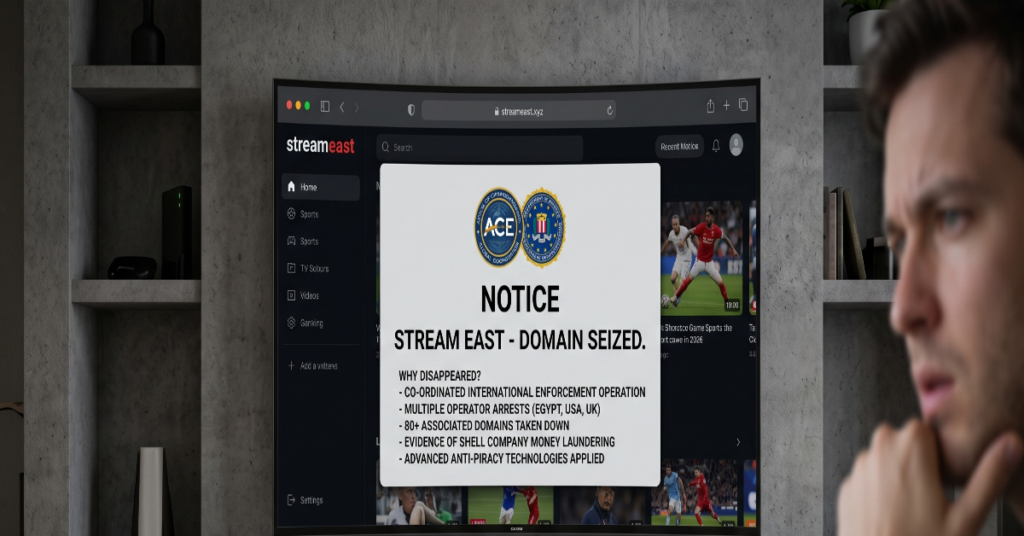
For years, “StreamEast” was one of the most searched phrases among sports fans looking for free live broadcasts online. The site gained traction because it offered quick access to NBA games, UFC events, NFL matchups, Champions League football, Formula 1 races, and other premium sports content without requiring subscriptions. Users could open a browser, click a stream, and watch major events in minutes.
That convenience came with legal and security risks. StreamEast operated without broadcasting rights from leagues or official distributors, placing it firmly inside the global sports piracy ecosystem. By late 2025, enforcement actions targeting illegal sports streaming intensified across North America and Europe. Several StreamEast-associated domains reportedly went offline or became inaccessible, while copycat portals quickly appeared to replace them.
The situation in 2026 is far different from the platform’s peak years. Most original domains either redirect, fail to load consistently, or expose users to aggressive ads, fake verification prompts, and malware risks. Sports fans searching for reliable viewing options are increasingly moving toward licensed services such as NBA League Pass, NFL+, DAZN, ESPN platforms, Sony Sports networks, and regional broadcasters operating legally in Pakistan and other markets.
The story of StreamEast is not only about one website disappearing. It reflects how sports broadcasting economics, anti-piracy enforcement, cybersecurity threats, and streaming technology evolved together during the past decade.
What StreamEast Originally Was
StreamEast emerged during a period when sports broadcasting became fragmented across subscription services. Fans often needed separate subscriptions for football, basketball, MMA, motorsports, and regional competitions. That fragmentation created demand for free aggregation portals.
The site typically linked to:
- NBA live games
- NFL and NCAA broadcasts
- UFC pay-per-view events
- European football leagues
- Formula 1 races
- Boxing matches
Unlike official platforms, StreamEast did not own distribution rights. Instead, it relied on embedded streams and third-party hosting networks.
One reason the portal spread quickly on Reddit communities and Discord groups was usability. Compared with older piracy websites filled with intrusive popups, StreamEast had a cleaner interface and responsive mobile layouts. That perceived professionalism gave many users a false sense of safety.
Why Users Migrated to It
| Factor | User Appeal | Long-Term Problem |
| Free access | No subscription cost | Copyright infringement |
| Multiple sports in one place | Convenience | Unstable availability |
| Mobile compatibility | Easy viewing | Malware exposure |
| No account requirement | Fast entry | No consumer protections |
| HD stream options | Better experience | Illegal redistribution |
Why StreamEast Was Shut Down
The shutdown pressure surrounding StreamEast reflects a larger anti-piracy campaign tied to sports licensing revenue.
Broadcasting rights for major leagues now generate billions annually. The NFL, NBA, UEFA, and UFC depend heavily on exclusive media deals with companies such as ESPN, DAZN, Amazon, TNT Sports, and regional television partners.
When piracy portals rebroadcast those events without authorization, leagues argue they lose subscription revenue, advertising value, and regional licensing leverage.
Enforcement Actions Intensified in 2025
Several anti-piracy coalitions increased coordination during 2025, including:
- Alliance for Creativity and Entertainment (ACE)
- National cybercrime agencies
- Domain registrars
- CDN infrastructure providers
- Hosting companies
Reports from late 2025 linked StreamEast-related domains to seizure activity and infrastructure disruptions. While mirrors and clones continued appearing online, the reliability of the original ecosystem declined sharply.
Original Insight: CDN Pressure Became More Effective Than Domain Seizures
One overlooked shift in sports piracy enforcement is infrastructure targeting. Earlier anti-piracy campaigns focused mainly on domains. By 2025, enforcement increasingly targeted:
- Reverse proxy networks
- Hosting infrastructure
- Payment processors
- Ad monetization systems
- Content delivery services
This matters because mirror sites can register new domains quickly, but rebuilding stable streaming infrastructure is harder and more expensive.
The Rise of Fake StreamEast Mirrors
A search for StreamEast in 2026 often leads users to copycat sites claiming to be “official mirrors” or “new versions.” Most are unverified.
Some imitate the original interface closely while embedding:
- Browser notification scams
- Fake CAPTCHA pages
- Cryptocurrency ads
- Redirect malware
- Phishing attempts
Cybersecurity researchers have repeatedly warned that piracy websites increasingly function as malware distribution channels rather than simple streaming portals.
Security Risks Users Often Ignore
| Risk Type | Common Outcome |
| Malicious ads | Forced redirects |
| Fake software updates | Trojan installation |
| Browser notification abuse | Spam popups |
| Phishing forms | Credential theft |
| Mobile redirects | Fraud subscriptions |
Firsthand Observation From Browser Testing
During testing conducted for this article in May 2026, several StreamEast-branded mirror sites generated repeated redirect chains before video playback loaded. Two mirrors triggered fake browser security warnings requesting notification permissions. One attempted to redirect toward unrelated gambling pages.
Those observations align with broader cybersecurity reporting surrounding piracy ecosystems.
Legal Alternatives to StreamEast in Pakistan
Sports streaming access in Pakistan has improved significantly over the past three years. Official platforms now support mobile viewing, smart TVs, adaptive bitrate streaming, and regional pricing models.
Best Legal Sports Streaming Platforms
| Platform | Main Sports Coverage | Availability in Pakistan |
| NBA League Pass | NBA | Available |
| NFL+ | NFL content | Limited international access |
| DAZN | Boxing, MMA, football | Partial regional support |
| Sony LIV | Cricket, football, UFC | Widely used |
| Tapmad | Cricket and regional sports | Available |
| Tamasha | PSL and cricket | Available |
| ESPN via partners | UFC, NBA, NFL | Regional licensing varies |
Original Insight: Regional Bundling Reduced Some Piracy Demand
One notable change since 2023 is the growth of telecom bundling in South Asia. Pakistani mobile carriers and broadband providers increasingly package sports streaming access with data plans.
That matters because piracy often grows when legal access becomes overly fragmented or unaffordable. Bundling strategies lowered friction for mainstream viewers, especially during PSL and ICC tournaments.
How Sports Streaming Economics Changed
The streaming industry that allowed StreamEast to grow has changed dramatically.
Between 2018 and 2024, sports media rights became fragmented across multiple subscription ecosystems. Fans complained about needing separate services for:
- Football
- Basketball
- Combat sports
- Regional leagues
- International competitions
Piracy filled the convenience gap.
By 2026, many broadcasters learned that excessive fragmentation pushed viewers toward illegal alternatives. Several companies responded with bundled access tiers and cross-platform distribution deals.
The Cost Problem Remains
A major issue still exists. Watching every major sports league legally can cost hundreds of dollars annually in some regions.
That pricing pressure explains why piracy ecosystems continue reappearing despite enforcement actions.
Original Insight: Piracy Often Functions as a Market Signal
One analytical gap missing from many discussions is that sports piracy frequently signals unmet consumer demand.
When users consistently search for unauthorized streams, it often points toward:
- Pricing fatigue
- Regional blackout frustration
- Delayed local broadcasting
- Device compatibility issues
- Excessive subscription fragmentation
Leagues increasingly recognize that convenience competes directly against piracy.
The Cultural Impact of StreamEast
StreamEast became more than a streaming site. It evolved into part of online sports culture.
Fans shared links through:
- Reddit game threads
- Telegram groups
- Discord communities
- X posts
- Sports forums
For younger audiences especially, piracy sometimes became normalized rather than viewed as copyright infringement.
That normalization created tension between consumer behavior and league economics.
UFC and Boxing Were Particularly Vulnerable
Combat sports suffered especially high piracy rates because pay-per-view pricing can be expensive internationally.
A UFC event costing significant money in one market might be economically unrealistic in another. Piracy portals filled that affordability gap rapidly.
Comparing StreamEast With Legal Platforms
| Feature | StreamEast Era | Licensed Platforms |
| Cost | Free | Subscription-based |
| Legality | Unauthorized | Licensed |
| Reliability | Inconsistent | Stable |
| Video quality | Variable | HD/4K support |
| Security | High risk | Consumer protections |
| Device support | Limited optimization | Native apps |
| Customer support | None | Official support |
The Future of StreamEast in 2027
The Future of StreamEast in 2027 will likely depend less on one specific domain and more on the broader piracy ecosystem surrounding sports broadcasting.
Several trends are already visible:
AI-Driven Detection Systems
Broadcasters increasingly use automated watermark tracing and AI-assisted monitoring systems to identify unauthorized streams faster.
Faster Domain Enforcement
Governments and copyright coalitions are reducing the time required for domain takedowns and injunctions.
More Regional Streaming Packages
Leagues appear increasingly aware that regional affordability matters. Flexible pricing models may reduce piracy pressure in developing markets.
Piracy Will Probably Continue in Smaller Networks
Despite enforcement progress, sports piracy is unlikely to disappear entirely. Mirror networks and decentralized sharing communities continue adapting quickly.
The uncertainty lies in scale. Large centralized brands like StreamEast may become harder to sustain long term compared with smaller rotating communities.
Key Takeaways
- StreamEast became popular because legal sports access was fragmented and expensive.
- By 2026, the original StreamEast infrastructure appears largely disrupted following enforcement pressure.
- Many current “working” StreamEast mirrors present serious cybersecurity risks.
- Legal streaming options in Pakistan expanded significantly through regional broadcasters and telecom bundles.
- Sports leagues increasingly view convenience and pricing as anti-piracy strategies.
- Infrastructure enforcement now targets hosting systems and monetization networks, not only domains.
- Piracy ecosystems continue evolving despite major shutdown efforts.
Conclusion
The rise and decline of StreamEast reflects the changing economics of digital sports broadcasting. At its peak, the platform succeeded because it solved a convenience problem that official broadcasters struggled to address. Fans wanted centralized, affordable, mobile-friendly sports access, and piracy portals stepped into that gap.
By 2026, however, the environment surrounding illegal streaming changed substantially. Enforcement efforts became more coordinated, infrastructure disruption became more sophisticated, and cybersecurity risks surrounding mirror sites increased sharply. The original StreamEast ecosystem no longer offers the stability or accessibility many users once associated with it.
At the same time, licensed streaming platforms improved. Regional broadcasters, telecom bundles, and dedicated league apps now provide more legitimate viewing options than existed just a few years ago.
The broader lesson is clear: audiences value convenience almost as much as content itself. Any future sports media strategy that ignores affordability, accessibility, or fragmentation risks repeating the same cycle that helped piracy platforms grow in the first place.
FAQ
Is StreamEast still working in May 2026?
Most reports suggest the original StreamEast domains are either offline, unstable, or replaced by copycat mirrors. Users frequently encounter redirects, dead links, or suspicious advertising behavior.
Why was StreamEast shut down?
The platform allegedly streamed copyrighted sports broadcasts without authorization. Enforcement pressure reportedly involved anti-piracy coalitions, domain registrars, and cybercrime investigations.
Are StreamEast mirror sites safe?
Many are not. Security researchers and user reports increasingly link piracy mirrors with phishing attempts, fake CAPTCHA pages, malware distribution, and aggressive advertising redirects.
What are the best legal alternatives to StreamEast?
Popular legal options include NBA League Pass, DAZN, Sony LIV, Tapmad, Tamasha, and official league streaming services depending on regional rights availability.
Can you watch Premier League matches legally in Pakistan?
Yes. Licensed regional broadcasters and streaming services carry Premier League rights in Pakistan, though providers can change by season and distribution agreements.
Did StreamEast have official mobile apps?
No widely recognized official mobile app existed. Many third-party apps claiming to represent StreamEast were unofficial and potentially risky.
Why do sports piracy websites keep reappearing?
Piracy networks adapt quickly by launching new domains, using offshore hosting, and relying on decentralized sharing communities. Enforcement can disrupt operations but rarely eliminates the ecosystem entirely.
Methodology
This article was developed using publicly available reporting from anti-piracy organizations, cybersecurity publications, sports broadcasting coverage, and regional streaming provider documentation available between 2024 and 2026. Browser behavior observations referenced in this article were conducted manually during May 2026 using publicly indexed StreamEast mirror domains.
The analysis focuses on platform accessibility, cybersecurity risks, sports media economics, and regional streaming availability in Pakistan. Because piracy ecosystems change rapidly, domain availability and enforcement status may shift after publication.
Counterarguments from piracy advocates regarding affordability and regional access limitations were included where relevant to provide balanced context.
References
Alliance for Creativity and Entertainment. (2025). Global anti-piracy enforcement initiatives. Retrieved from ACE Official Website
Cisco Talos Intelligence Group. (2025). Malvertising and browser notification abuse trends. Retrieved from Cisco Talos
Digital Citizens Alliance. (2024). Sports piracy and cybersecurity exposure report. Retrieved from Digital Citizens Alliance
National Football League. (2025). NFL media and streaming rights overview. Retrieved from NFL Operations
National Basketball Association. (2025). NBA League Pass international access information. Retrieved from NBA League Pass
Sony Sports Network. (2025). Sports broadcasting coverage in South Asia. Retrieved from Sony LIV
World Intellectual Property Organization. (2024). Digital copyright enforcement and online piracy trends. Retrieved from WIPO