
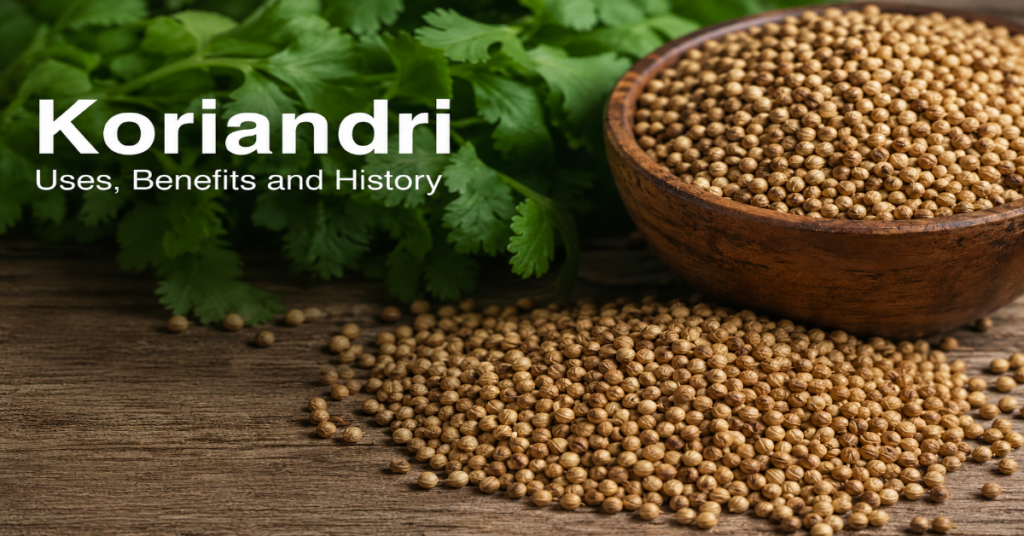
Koriandri is the Estonian word for coriander, the plant known scientifically as Coriandrum sativum. It belongs to the Apiaceae family, the same botanical family that includes parsley, dill, fennel and carrot. In everyday cooking, coriander is unusual because the same plant gives cooks several distinct ingredients: dried seeds, fresh leaves and aromatic roots.
That difference matters. Coriander seeds are warm, citrusy and slightly nutty. Fresh coriander leaves, often called cilantro in North America, are bright, sharp and grassy. The roots are earthier and more concentrated, especially important in Thai curry pastes and marinades.
This guide explains what koriandri means, how coriander is used in food, why some people think cilantro tastes soapy, what modern research says about its health properties and how to grind, store and grow it properly.
Coriander is not a passing food trend. Britannica describes it as an annual plant native to the Mediterranean and Middle East, widely cultivated for culinary use, with both herb and spice applications. Research reviews also describe coriander as rich in polyphenols, essential oils and other bioactive compounds, though food use should not be confused with medical treatment.
For readers who follow Postcard.fm’s food culture coverage, this article also connects well with the site’s broader interest in how simple ingredients become cultural signals, much like its coverage of Toastul as a modern food trend.
What Koriandri Actually Means
Koriandri means coriander in Estonian. In practical terms, it refers to the same plant used across Indian, Middle Eastern, Mediterranean, Mexican, Thai and European cooking.
| Term | Where It Is Common | What It Usually Means |
| Koriandri | Estonia | Coriander as herb, seed or plant |
| Coriander | Europe, Asia, global food trade | Seeds or whole plant |
| Cilantro | United States, Canada | Fresh leaves and stems |
| Dhania | South Asia | Leaves or seeds depending on context |
| Chinese parsley | Some English-language markets | Fresh coriander leaves |
The confusion comes from regional naming, not botany. Coriander and cilantro are not separate species. They are different names for different parts of Coriandrum sativum.
Botanical Profile and Plant Structure
Coriander is a feathery annual herb with slender stems, white to pale pink flowers and small round fruits commonly called seeds. Botanically, the “seeds” are dried fruits, but in cooking and retail they are almost always sold as coriander seeds. Britannica identifies coriander as a member of the parsley family and notes its use as both herb and spice.
| Plant Part | Culinary Form | Flavor Profile | Best Uses |
| Leaves | Fresh herb | Bright, green, citrusy, grassy | Salsa, salads, chutneys, soups |
| Stems | Fresh aromatic | Stronger than leaves, juicy | Stocks, sauces, marinades |
| Seeds | Whole or ground spice | Warm, lemony, nutty, floral | Curries, rice, meats, pickles |
| Roots | Fresh aromatic base | Earthy, intense, savory | Thai curry paste, marinades, soups |
| Flowers | Edible garnish | Mild, herbal | Salads, plated dishes |
The leaves have lobed edges and a delicate structure, which is why they work well as a garnish but wilt quickly after cutting. Dried seeds are light brown, oval to round and aromatic when crushed.
Historical and Cultural Context
Coriander is one of the oldest known culinary herbs. It has been associated with Mediterranean and Middle Eastern foodways for centuries, and its use spread through trade, migration and empire. Historical accounts connect coriander with ancient Egyptian, Greek and Roman use, while modern culinary patterns place it at the center of South Asian, Southeast Asian, Latin American and North African cooking.
The plant also appears in biblical language, where coriander seed is used as a comparison for manna. That reference shows how familiar the seed was in ancient food culture.
| Period or Region | Coriander Role | Why It Mattered |
| Ancient Mediterranean | Food, medicine, preservation | Aromatic seeds helped flavor stored foods |
| Ancient Middle East | Bread, stews, ritual language | Common enough to appear in religious comparison |
| Roman food culture | Seasoning and preservation | Useful with meat, wine and sauces |
| South Asia | Spice blends, curries, chutneys | Works with cumin, turmeric, chili and ginger |
| Southeast Asia | Roots, stems, leaves | Builds curry paste and soup bases |
| Modern global kitchens | Herb, spice, garnish | Used across restaurant, home and packaged food |
One reason koriandri survived across cultures is that it solves several culinary problems at once. The seed adds warmth without heavy heat. The leaf adds freshness without sugar or acid. The root adds depth without meat.
Koriandri in Cooking: Seeds, Leaves and Roots
Coriander Seeds
Coriander seeds are the most stable and shelf-friendly form. Whole seeds keep their aroma longer than ground powder because the essential oils remain protected inside the seed coat.
They are widely used in:
- Garam masala
- Curry powder
- Pickling spice
- Sausage seasoning
- Lentil dishes
- Roasted vegetables
- Rice pilafs
- Seafood rubs
Coriander seed pairs especially well with cumin. Cumin brings earth and smoke. Coriander brings citrus and lift. Together, they form the backbone of countless spice blends.
Fresh Leaves
Fresh coriander leaves are more delicate. They should usually be added near the end of cooking or used raw.
Common uses include:
- Tomato salsa
- Green chutney
- Noodle soups
- Fresh salads
- Tacos
- Lentil soups
- Rice bowls
- Yogurt sauces
A common mistake is treating coriander leaves like dried oregano or thyme. Long cooking destroys their freshness. Add them late unless the recipe is using stems in a cooked base.
Roots and Stems
Coriander roots are less common in European supermarkets but valuable in Thai cooking. They are often pounded with garlic, peppercorns, lemongrass and chilies to make curry pastes and marinades.
Stems are a practical substitute when roots are unavailable. They carry more flavor than leaves and handle heat better.
Coriander Seed vs Cilantro Leaves
| Feature | Coriander Seeds | Fresh Cilantro Leaves |
| Plant Part | Dried fruit, commonly called seed | Fresh leaf and tender stem |
| Flavor | Warm, citrusy, nutty, floral | Bright, grassy, sharp, fresh |
| Shelf Life | Long if whole and dry | Short, usually days |
| Cooking Timing | Early or middle of cooking | Late cooking or raw finish |
| Best Technique | Toast, cool, grind | Wash, dry, chop just before use |
| Common Regions | India, Middle East, Europe, North Africa | Mexico, Thailand, Vietnam, South Asia |
| Main Risk | Stale powder loses aroma | Wilting, bruising, soapy perception |
Why Cilantro Tastes Soapy to Some People
The soapy cilantro debate is real. A 2023 review in International Journal of Gastronomy and Food Science discusses coriander as a divisive herb, including sensory differences linked to aroma perception.
Fresh coriander leaves contain aldehydes, a group of aromatic compounds also found in soaps and some cleaning products. Many people perceive those compounds as fresh and citrusy. Others experience them as soapy or unpleasant.
This does not mean the herb is bad. It means flavor perception is partly biological. For recipe developers, caterers and restaurants, this creates a practical trade-off: coriander can make a dish feel vivid and fresh to one group while making it difficult to eat for another.
Health Context: What Research Supports and What It Does Not
Traditional medicine systems have used coriander for digestion, appetite, inflammation and general wellness. Modern research is more cautious. Reviews describe coriander as containing polyphenols, vitamins, essential oils and other compounds associated with antioxidant activity.
A 2024 review on therapeutic effects of Coriandrum sativum summarizes experimental interest in several biological effects, but much of the evidence still comes from laboratory, animal or early-stage studies rather than large clinical trials.
| Claim Area | Current Evidence Level | Practical Interpretation |
| Digestive comfort | Traditional use plus experimental support | Reasonable as a culinary digestive spice |
| Antioxidant compounds | Supported by phytochemical studies | Coriander contributes plant compounds |
| Blood sugar support | Early research interest | Not a substitute for medical care |
| Antimicrobial effects | Lab-based evidence exists | Does not replace food safety practices |
| Weight or metabolic claims | Investigational | Avoid exaggerated supplement claims |
The honest position is simple: koriandri is a nutritious culinary ingredient with interesting bioactive compounds. It should not be marketed as a cure.
Practical Kitchen Technique: How to Grind Coriander Seeds
The biggest flavor difference comes from grinding seeds properly.
- Heat a dry pan over medium heat.
- Add whole coriander seeds.
- Toast for 30 to 60 seconds until fragrant.
- Remove from heat and cool.
- Grind with a mortar and pestle or spice grinder.
- Use immediately or store in an airtight jar away from heat.
Do not grind hot seeds immediately. Heat releases aromatic oils, but grinding while hot can drive off aroma too quickly. Cooling protects the flavor.
A good test is smell. Freshly ground coriander should smell lemony, warm and slightly floral. If it smells dusty, bitter or flat, it is past its best.
Storage, Shelf Life and Quality Control
Fresh coriander leaves are fragile. Treat them like a leafy herb, not a hard vegetable.
| Form | Best Storage Method | Expected Quality Window |
| Fresh leaves | Wrapped in a damp towel or stored upright in water | 3 to 7 days |
| Fresh stems | Refrigerated, loosely covered | 3 to 7 days |
| Roots | Refrigerated, wrapped and dry | 5 to 10 days |
| Whole seeds | Airtight jar, dark cupboard | 1 to 2 years |
| Ground powder | Airtight jar, dark cupboard | 3 to 6 months for best aroma |
The hidden limitation is not safety, but quality. Ground coriander may remain usable after several months, yet the volatile aroma fades fast. For serious cooking, whole seeds are the better purchase.
Growing Koriandri at Home
Coriander is easy to start but easy to mishandle. The plant prefers cool to mild conditions, loose soil and consistent moisture. Heat stress causes bolting, meaning the plant quickly flowers and shifts from leaf production to seed production.
| Growing Factor | Best Condition | Common Mistake |
| Temperature | Cool to mild | Planting during peak heat |
| Soil | Loose, well-drained | Heavy wet soil |
| Water | Even moisture | Overwatering or drying out |
| Light | Sun to partial sun | Harsh afternoon heat in hot climates |
| Harvest | Cut outer leaves first | Pulling whole plant too early |
| Succession | Sow every 2 to 3 weeks | Expecting one planting to last all season |
For home growers, the smartest approach is succession sowing. Plant a small amount every few weeks rather than one large batch. This reduces the frustration of having all plants bolt at once.
Postcard.fm readers interested in practical home growing and habitat design may find useful context in the site’s guide to attracting birds to your yard, since both topics depend on matching plants, water and microclimate to living systems.
Market, Cultural and Real-World Impact
Coriander sits at the intersection of food culture, agriculture and global migration. It is not just a spice used in one regional cuisine. It is a shared ingredient across continents.
FAOSTAT provides global agricultural data across countries and crop groups, though spice-specific reporting can vary by classification and country reporting quality. FAO’s broader 2023 agricultural statistics show global primary crop production continued rising, with total primary crop output reaching 9.9 billion tonnes in 2023.
That context matters because herbs and spices are vulnerable to the same pressures affecting larger crops:
- Heat stress
- Water availability
- Transport costs
- Labor costs
- Packaging inflation
- Quality control in global supply chains
For restaurants, coriander is also a menu design issue. In Thai, Mexican, Indian and Vietnamese dishes, removing coriander can change the identity of the dish. But leaving it in can alienate cilantro-sensitive customers. Many kitchens now solve this by using coriander stems and seeds in cooked bases, then offering fresh leaves as a garnish.
Strategic Implications for Cooks, Brands and Restaurants
Koriandri creates different opportunities depending on who is using it.
| User Type | Best Opportunity | Main Risk |
| Home cooks | Better flavor through whole seeds | Buying stale powder |
| Restaurants | Freshness and global authenticity | Cilantro aversion among guests |
| Food brands | Clean-label flavor building | Overuse in products for broad audiences |
| Gardeners | Fast herb harvests | Bolting in heat |
| Nutrition writers | Evidence-based herb coverage | Exaggerated health claims |
| Retailers | Sell seeds, leaves and plants separately | Confusing labeling |
For food brands, coriander works because it adds recognizable complexity without requiring artificial flavor systems. For home cooks, its best value is cost efficiency. A small jar of whole seeds can improve soups, rice, beans and roasted vegetables for months.
For restaurants, the best strategy is transparency. If a dish is coriander-forward, say so. If fresh cilantro is optional, serve it separately.
The same logic appears across other Postcard.fm food and lifestyle coverage: simple objects become meaningful when the use case is clear, as seen in the site’s article on staycation food and cooking activities.
Original Editorial Insights
1. The root is the missing part in many Western recipes
Most Western grocery systems sell leaves and seeds but ignore roots. That changes how people understand the plant. In Thai cooking, the root is not decorative. It is structural. When roots are unavailable, stems are the closest practical substitute.
2. Coriander solves flavor balance without adding acid
Many recipes rely on lemon juice or vinegar for brightness. Fresh coriander can add perceived freshness without increasing acidity, which is useful in yogurt sauces, lentil dishes and rich soups.
3. The cilantro aversion problem is a menu design issue, not just a preference issue
Because some diners experience cilantro as soapy, restaurants should treat fresh coriander like chili heat or raw onion: desirable for some, intrusive for others. Offering it as a finishing garnish can protect the dish and the diner.
4. Whole seeds are a better sustainability purchase than ground powder
Whole seeds last longer, waste less aroma and reduce the chance that consumers discard stale spice jars. This is a small but practical kitchen efficiency gain.
Risks and Trade-Offs
Coriander has clear advantages, but it is not universally easy.
- Fresh leaves spoil quickly: Waste is common if bunches are stored wet or crushed.
- Flavor divides people: Cilantro aversion is real enough to affect recipe acceptance.
- Ground spice degrades fast: Old coriander powder can make food taste dull.
- Heat affects cultivation: Warm weather causes bolting and reduces leaf harvests.
- Health claims can be overstated: Research supports interest, not miracle claims.
The best use of koriandri is confident but restrained. Let the seed support a dish. Let the leaf finish it. Do not force either where it does not belong.
The Future of Koriandri in 2027
By 2027, coriander will likely remain a mainstream global ingredient, but its use may become more precise.
Three trends are worth watching.
First, controlled environment agriculture may improve fresh herb supply in urban markets. Indoor farms can reduce weather exposure, though cost and energy use remain constraints.
Second, global restaurant formats will keep spreading coriander-heavy cuisines. Thai curry, Vietnamese pho, Mexican salsa, Indian chutney and Middle Eastern spice blends all rely on some form of the plant.
Third, functional food companies will likely keep exploring coriander extracts because reviews continue to highlight its polyphenols, essential oils and antioxidant activity. The risk is marketing exaggeration. A herb can be valuable without being oversold as a treatment.
Climate volatility is the serious constraint. Coriander grows quickly, but fresh leaf production is sensitive to heat. In hotter regions, growers may need shade, staggered planting or protected cultivation to maintain quality.
Takeaways
- Koriandri is simply the Estonian term for coriander, but the ingredient has global culinary reach.
- Seeds, leaves and roots should be treated as separate ingredients with separate techniques.
- Whole coriander seeds deliver better flavor and longer shelf life than pre-ground powder.
- Cilantro aversion is linked to sensory perception, so fresh leaves should sometimes be optional.
- Coriander has promising phytochemical research, but it should be framed as food, not medicine.
- Home growers should focus on cool conditions, drainage and succession sowing.
- The plant’s future depends on better labeling, smarter storage and climate-aware cultivation.
Conclusion
Koriandri is a small word for a large culinary story. It points to coriander, but coriander itself is not one thing in the kitchen. It is a warm seed, a bright leaf, a powerful root and a cultural bridge between ancient food systems and modern global cooking.
Its value comes from versatility. Coriander can deepen a curry, lift a salsa, sharpen a soup or anchor a spice blend. It also demands respect. Fresh leaves spoil fast. Ground powder fades. Some people dislike the flavor for biological reasons.
The best approach is practical: buy whole seeds, grind them fresh, use leaves late and treat stems as useful rather than disposable. When handled well, coriander earns its place as one of the world’s most important herbs.
FAQ
What does koriandri mean?
Koriandri means coriander in Estonian. It refers to Coriandrum sativum, the plant used for coriander seeds, fresh coriander leaves and roots. In North America, the fresh leaves are often called cilantro.
Mis vahe on koriandril ja cilantrol?
Koriander and cilantro come from the same plant. In many English-speaking regions, coriander usually means the dried seeds, while cilantro means the fresh leaves and stems. In Estonian, koriandri can refer to coriander more broadly.
Millistes roogades kasutatakse koriandriseemneid?
Coriander seeds are used in curries, rice dishes, pickles, sausages, lentil soups, roasted vegetables, seafood rubs and spice blends such as garam masala and curry powder.
Millised on koriandri tervisemõjud?
Coriander contains polyphenols, essential oils and antioxidant compounds. Traditional use links it with digestion, but it should be treated as a culinary ingredient, not a medical treatment. Current research is promising but not definitive.
Kuidas koriandriseemneid õigesti jahvatada?
Toast whole seeds briefly in a dry pan, cool them, then grind with a mortar and pestle or spice grinder. Use the powder soon after grinding because aroma fades quickly.
Kuidas koriandrit kodus kasvatada?
Grow coriander in loose, well-drained soil during cool to mild weather. Keep moisture consistent, avoid intense heat and sow small batches every few weeks to reduce bolting.
Why does cilantro taste like soap to some people?
Fresh coriander leaves contain aldehyde compounds. Some people perceive these as fresh and citrusy, while others experience them as soapy or unpleasant. The difference is linked to sensory biology and aroma perception.
Methodology
This article was drafted from the supplied Postcard.fm production brief and keyword details, then checked against botanical, culinary and scientific sources. The main validation sources included Britannica for botanical identity and origin, peer-reviewed review literature for phytochemistry and health context, FAO resources for agricultural data framing and Postcard.fm pages for internal linking context.
No laboratory testing, clinical testing or original field trial was conducted for this article. Practical kitchen guidance is based on standard culinary technique and should be reviewed by a human editor before publication. Health-related sections are intentionally cautious because many coriander studies are preclinical, review-based or focused on extracts rather than normal food portions.
References
Anaeigoudari, A., et al. (2024). Therapeutic effects of Coriandrum sativum extracts: A review. Advanced Pharmaceutical Bulletin.
Britannica. (2026). Coriander: Physical description, uses, history of use, and facts. Encyclopaedia Britannica.
Food and Agriculture Organization of the United Nations. (2024). Agricultural production statistics 2010 to 2023. FAO.
Mahleyuddin, N. N., et al. (2021). Coriandrum sativum L.: A review on ethnopharmacology, phytochemistry and pharmacology. Molecules.
Scandar, S., et al. (2023). Coriander (Coriandrum sativum) polyphenols and their nutraceutical value. Plants.
Spence, C. (2023). Coriander, cilantro: A most divisive herb. International Journal of Gastronomy and Food Science.